
"Pacific Coffee China"
1000 article(s) found

Find those chain cafes that coffee accompanies you
Cafe, a synonym for the city-driven economy, we have been looking for the kind of place where we can sit comfortably whenever we want, slow down our lives, drink coffee, daydream, look out the window and chat with friends. Life is a journey. We can go to any city to live, work, drink coffee and see the scenery. Coffee is for you.

Those chain cafes have coffee with you (caffebene)
Coffee shop, a synonym for the city to drive the economy, we have been looking for that, whenever you go to sit down will be very comfortable, let life slow down, drink coffee, think about it, look out of the window and chat with friends. Life is a trip. We can go to any city to live, work, drink coffee and see the scenery. Sagebrush coffee is looking for those companies for you.

15% of consumers are affected by the environment and atmosphere-the number of cafes in China will increase in the past five years.
China has a tradition of tea culture, but compared with the prosperity of cafes, the development of Chinese teahouses is tepid, with an increase of 4 per cent from 48842 to 50984 between 2007 and 2012. MatthewCrabbe, director of Asia Pacific Research at Mintel, said that after the coffee chain entered China in the late 1990s, it expanded at a faster speed, but teahouses always struggled to find a way out and eventually consumed.

After 17 years of entry into the Chinese market, Starbucks has exceeded 2000 stores in China for the first time.
In order to continue to advance by leaps and bounds in the Chinese market, Schultz announced a series of welfare programs for Chinese partners on the same day, including a housing subsidy program that can cover 50% of the average rent expenditure in the cities where the partners are located. Schultz is very optimistic about the extremely high profit margins from the Chinese market. Starbucks' previous financial statements showed that profit margins in China and the Asia-Pacific region reached 32%, while those in the Americas region
Starbucks plans to rapidly expand stores in China to speed up "local transformation and development"
As a global chain, Starbucks now has a market capitalization of 553.1 billion yuan. In the fourth quarter of last year, Starbucks' global profits hit a record high, with global store sales up 8%. Of this total, store sales in China and the Asia-Pacific region increased by 6%. The number of white-collar workers in China has grown rapidly in recent years, which is also the main consumer group of Starbucks operating in China. In the process of China's economic transformation

Starbucks stores in China are on the rise to surpass those of Japan
A number of executives, including the company's CEO, Howard Schultz (Howard Schultz), were interviewed by the Nippon Economic News (Chinese version: Nikkei Chinese website) a few days ago. Referring to the Chinese market, Schultz pointed out that the middle class is growing and the demand for goods and services with strong brand appeal is increasing. Among emerging market countries, Starbucks is especially in China.

Why don't the capital bosses of 70 billion yuan coffee market like it?
According to statistics, the scale of China's coffee consumption market reached 70 billion yuan in 2015, and it is breaking out at an annual growth rate of 15%, reaching trillion yuan by 2025. With a market size of 70 billion yuan and a market growth rate of 15%, why is capital dismissive of such a thriving industry? Why does the capital despise the coffee industry? the development of the industry is distorted and deviates from the commercial track.
Starbucks embarks on the road of "espresso" in China
Driven by caffeine, Starbucks coffee (Starbucks) has seen explosive growth in Asia. Starbucks plans to expand its 500 stores in China to at least 1500 stores in the next three years, according to a company announcement. The report predicts that by 2014, the company's business in China will become the second largest market outside the United States.

Pacific Coffee Hope Teaching Building completed in Tianshui City, Gansu Province
On October 10, 2014, teachers and students of Xingfeng Township Central Primary School in Qin'an County, Tianshui City, Gansu Province moved happily into their long-awaited brand-new comprehensive teaching building. The newly completed complex was funded by Pacific Coffee through donations from the pro bono nursery initiative. The two-storey teaching building has a total construction area of 96336 square meters and has a total of 9 classrooms and 7 function rooms.

Why can't Starbucks, which has more than a thousand stores in China, find a store in Italy?
According to people who came back from a business trip and a trip to Italy, Starbucks coffee shops could not be found there. In China, Starbucks opened an average of one new store every day in fiscal year 2014, and this year's goal is to open a new store within 18 hours. Not a single store can be found within 300 miles. Recently, according to people who came back from a business trip or trip to Italy, Starbucks coffee could not be found there.

What's the prospect of opening a coffee shop? Is it difficult to start a coffee shop?
In recent years, with the rise of cafes everywhere, the cafe war has broken out, and the intervention of capital has pushed it to the best part. Compared with the international chain giants with a strong financial background, domestic chain brands with broad development prospects such as carving time have attracted the help of PE/VC. It is undeniable that due to lack of profitability and lack of linkage genes, domestic investment value
Changsha cafes have more than 1,000 Starbucks and 10 stores in Changsha in two years.
In the fast age when the heel kicks on the back of the head, the door of coffee is open, allowing you to turn your back to the world for a while and enjoy a slow life. Coffee, a Poly drink, is very popular in Changsha, central China. In the streets of Changsha, the mellow aroma of coffee from the West spreads wantonly. Starbucks from the United States has opened 10 stores in two years, including British costa Coffee, Hong Kong Pacific Coffee,

Chinese famous wine blending delicious fancy coffee
There is no lack of coffee drinks mixed with western wine in the history of Chinese famous wine blending delicious fancy coffee, but Chinese fine wine combined with western-style coffee and officially launched for the market is still the first in the industry: Girls red coffee? What kind of feeling was this? Or, in a bookstore with a strong traditional Chinese culture, smell books and taste coffee. Time shuttles, Chinese and Western are combined, and the delicious food is more wonderful.

Korean coffee is expanding crazily in China, rising and falling in just one year.
Stores are closed, franchisees run away, Korean coffee brands continue to storm, exposing the problem of insufficient management control under the rapid growth of enterprise scale. According to RET Rui Yide's "Research report on the Development trend of Korean Coffee Shop in China", Korean coffee brands tend to join or co-operate as the main expansion mode, of which the proportion of coffee with you accounts for 10%, and that of zoo coffee is higher than that of zoo coffee.
The first British COSTA coffee shop in Qingdao opened 10 stores in May 4th Square within three years of opening.
British coffee giant Kashijia stationed in the island city of Starbucks, Pacific, 85C Qingdao style coffee taste is becoming more and more international. It is optimistic about this market. British COSTA Coffee, one of the five largest coffee chains in the world, recently opened gracefully in the May 4th Square in the island city. Zhao Junhui, regional manager of Hualian Kashijia (Beijing) Restaurant Management Co., Ltd., told reporters: coffee in mainland China.
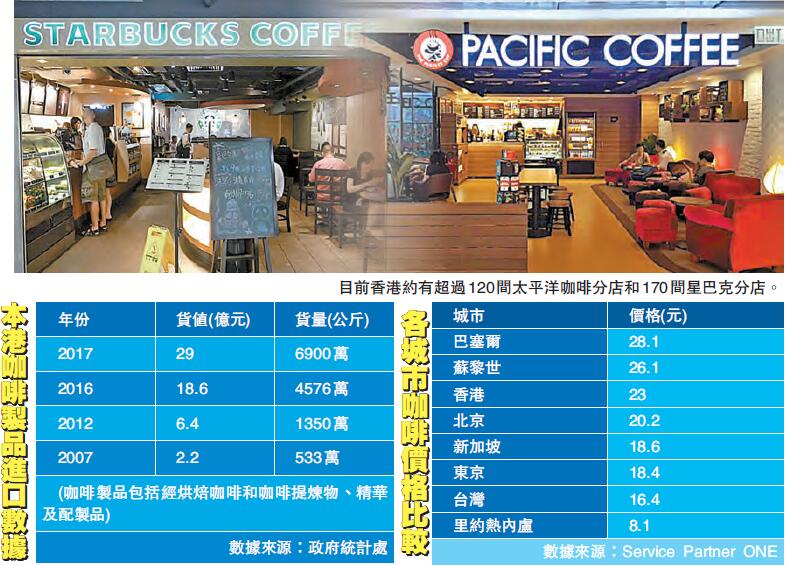
How should Starbucks VS Pacific Native Coffee Brand find a way out
Professional coffee knowledge exchange more coffee bean information please follow the coffee workshop (Wechat official account cafe_style) Source: Hong Kong Business Daily is walking in Central, many white-collar workers who come and go in a hurry in suits and shoes will take it in their hands? A cup of coffee. Although they call themselves migrant workers in Central, white-collar workers are happy with coffee with an average of 40 or 50 yuan per cup. Former Financial Secretary Zeng Jun

2015 China (Chengdu) International Coffee Industry and Coffee Culture Expo opens to attract investment
The 2015 China (Chengdu) International Coffee Industry and Coffee Culture Expo (CICCE 2015), which will be opened at Chengdu Century City New International Convention and Exhibition Center from December 4 to 6, 2015, has been launched in an all-round way, and its influence has permeated both at home and abroad. CICCE 2015 is co-sponsored by the Nutrition guidance Committee of China Food Industry Association and Beijing Zhonghuit Exhibition Co., Ltd.
Top 10 Coffee Chain Brands, Who Are They?
Coffee is one of the three most popular drinks in the world, and there are many famous coffee chain brands in the world. Xiaobian collects global coffee brands here. Starbucks opened its first store in the mainland of China in January 1999 at Beijing China International Trade Center. Starbucks currently operates more than 2000 stores in China. caffe pascucci

Yunnan Coffee What is the story of Yunnan coffee beans development process and the relationship between Nestle Starbucks
Professional coffee knowledge exchange More coffee bean information Please pay attention to coffee workshop (Weixin Official Accounts cafe_style) For Starbucks, there must be a forward-looking layout for China. Grasp the source (Yunnan coffee), it is possible to support the expansion of the store. US coffee chain Starbucks announced in mid-November that it will build its own coffee farm in Yunnan, China.

Coffee producing areas what are the coffee producing areas in China?
Professional coffee knowledge exchange more coffee bean information Please pay attention to the coffee workshop (Wechat official account cafe_style) with the equator as the center, in the tropics and subtropics between latitudes of about 25 degrees north and south, it is the most suitable area for growing coffee. However, good forests can not be cultivated anywhere in the region. The three major coffee growing areas in this section are as follows: